I've been doing some reading lately on my heritage language, Litvish Yiddish. The "Standard Yiddish" variety which is found in literature and academia is pretty close to Litvish, but I found to my frustration that Litvish forms aren't totally derivable from Standard. The main difference is that Standard has /oi/ in many words where Litvish has /ei/, e.g. Standard oivn, Litvish eivn 'oven'. The catch is that sometimes both have /oi/, e.g. Standard=Litvish hoiz 'house'. The question for me was: how can I learn Litvish from a book that teaches Standard?
Now, it turns out that Litvish /oi/ is the reflex of one particular vowel (something like */uw/) in Proto-Yiddish, denoted by the number 45 in Yiddish linguistics. Cognate words in Middle High German (MHG) have /u:/, and in Modern German /au/, e.g. German haus 'house'. Unfortunately Modern German /au/ also results from MHG /ou/, cognate to Litvish /ei/ e.g. MHG ouge, Modern German Auge, Litvish eig (Standard oig). This does, at least, mean that if a word doesn't have /au/ in Modern German, it won't have /oi/ in Litvish, so for example Modern German Brot 'bread' is breit in Litvish (cf. Standard broit).
Eventually I discovered that that the key lies with Dutch. Dutch also originally had */u:/ at an early stage in words with Yiddish 45, which eventually developed into /œy/, spelled ui. This is the only source of the vowel ui in Dutch. Thus to determine the form of a Standard word in Litvish, replace any "oi" with "ei" unless its Dutch cognate has ui. For example, Standard toib may mean either 'deaf' or 'dove'. Its cognates in Dutch are doof 'deaf' and duif 'dove'. Thus in Litvish, the words are teib 'deaf' and toib 'dove'.
Incidentally, some Litvish Yiddish varieties have /eu/ in words where the Standard has oi and (conventional) Litvish has ei, for instance having breut for broit/breit 'bread'.
Here is a nice map of the distribution of the Yiddish words for 'deaf' and 'dove' in Litvish Yiddish.
Monday, July 18, 2011

Saturday, May 14, 2011
Lateral stability
The letter 'sin' שֹ is known to have originally been pronounced distinctly from both 'shin' שׁ and 'samekh' ס. The letter 'sin' occurs precisely in words where Arabic has a /ʃ/ sound (like in ship), e.g. עשרה = Ar. /ʕaʃra/, showing that the common ancestor of Hebrew and Arabic had a distinct sound wherever this letter occurs. In fact, some obscure Semitic languages (the Modern South Arabian languages) have preserved this sound.
It's thought that sin was originally pronounced as a voiceless lateral fricative /ɬ/, like Welsh llwyd 'gray'. This sound is pronounced similarly to /l/ (as in land), but without vibration of the vocal cords, as if whispering, and often with a 'hushing' articulation. It's also often found in disordered speech. (I personally know someone who pronounces /ʃ/ as [ɬ] in English.) Some English loanwords show that sin had an l-like sound, like Balsam for Hebrew בשם and Chaldean for כשדי.
/ɬ/ (sin) and /s/ (samekh) must have begun merging quite early, since samekh is often used for sin in later books of the Tanakh. However Samaritans pronounce sin as /ʃ/, merging it with shin rather than samekh.
Why did the letter ש serve to indicate two consonants? The Hebrew alphabet was borrowed from the Phoenicians, for whom the sound /ɬ/ had already been lost, so the letter ש was adopted for this purpose. Actually other letters in the Hebrew alphabet also indicated multiple sounds, but that can wait for a different post...
It's thought that sin was originally pronounced as a voiceless lateral fricative /ɬ/, like Welsh llwyd 'gray'. This sound is pronounced similarly to /l/ (as in land), but without vibration of the vocal cords, as if whispering, and often with a 'hushing' articulation. It's also often found in disordered speech. (I personally know someone who pronounces /ʃ/ as [ɬ] in English.) Some English loanwords show that sin had an l-like sound, like Balsam for Hebrew בשם and Chaldean for כשדי.
/ɬ/ (sin) and /s/ (samekh) must have begun merging quite early, since samekh is often used for sin in later books of the Tanakh. However Samaritans pronounce sin as /ʃ/, merging it with shin rather than samekh.
Why did the letter ש serve to indicate two consonants? The Hebrew alphabet was borrowed from the Phoenicians, for whom the sound /ɬ/ had already been lost, so the letter ש was adopted for this purpose. Actually other letters in the Hebrew alphabet also indicated multiple sounds, but that can wait for a different post...
Tuesday, March 15, 2011
"ruach ra'ah" = "malaria"
According to DovBear, the familiar רוח רעה ruach ra'ah, literally 'bad air', is identified with miasma, a fictitious substance which was believed up to the 19th century to spread disease. It's interesting to note that the English word 'malaria' is derived from Italian mala aria, also literally 'bad air' (source).
Wednesday, March 2, 2011
open-minded
As a guilty user of the Israeli mivta, I naturally am not naturally disposed to know the correct way to niqqudize any particular word in Hebrew. I've found that historical Hebrew phonology has been very useful to understanding how the whole system works. Anyway, I felt like it might be interesting to talk about a particular aspect of niqqud that I've recently been thinking about. If this is boring, I apologize.
To simplify a complicated discussion, Hebrew went through a phase where vowels could be short or long*. At some point this length was lost, but by then long /a:/ was pronounced further back, as the vowel /ɔ/**. The Masoretes wrote /a/ with patah (אַ) and /ɔ/, reflecting older long /a:/, with qamatz (אָ).
A general rule in older Hebrew was that in open syllables*** /a:/ replaced /a/. Thus in open syllables patah is rarely found. However there are some interesting exceptions:
1) Words with hataf vowels, e.g. רַחֲמִים = ra-ha-mim, where the first syllable ra has a patah. It's thought that the hataf patah added in forms like this was a late addition: at a late stage shva nah under gutturals (like ה ע ח א) became a hataf vowel. This is also found in words with other vowels like צהֳרים, צהֳלה, יחֱרד
2) Segolates like נער, בעל, נחל (= na-hal where the first vowel is patah). The dating on these is, I believe, tricky. However it's known that originally segolates only had one vowel, e.g. *malk > melekh מלך, or similarly *nahl > nahal. Thus the first vowel was originally in a closed syllable, so this makes some sense.
3) Words like ירַחֵם = ye-ra-hem where the second vowel is a patah. In cases like this the guttural was originally doubled (ye-rah-hem), but gutturals lost gemination (= doubling) at a late stage. Thus we see in other piel verbs like ידבּר there is a dagesh in the second root letter because it was geminate (ye-dab-ber)
Are there any other cases that I have missed? Please let me know if you're aware of any. Also, I apologize for the ad-hoc transcription; I figure that it does not distract from my point, but if it's distracting I can use something more precise.
* This is roughly comparable to the difference between the vowel in British lot versus start, where the second is more drawn-out.
**This is the vowel in the word caught, for speakers who pronounce it differently than the word cot.
***An open syllable ends in a consonant, while a closed syllable ends in a vowel. Thus הברה Ha-va-ra has three open syllables while יד yad has one closed syllable.
Main source: Phonology and Morphology of Biblical Hebrew by Joshua Blau (2010)
To simplify a complicated discussion, Hebrew went through a phase where vowels could be short or long*. At some point this length was lost, but by then long /a:/ was pronounced further back, as the vowel /ɔ/**. The Masoretes wrote /a/ with patah (אַ) and /ɔ/, reflecting older long /a:/, with qamatz (אָ).
A general rule in older Hebrew was that in open syllables*** /a:/ replaced /a/. Thus in open syllables patah is rarely found. However there are some interesting exceptions:
1) Words with hataf vowels, e.g. רַחֲמִים = ra-ha-mim, where the first syllable ra has a patah. It's thought that the hataf patah added in forms like this was a late addition: at a late stage shva nah under gutturals (like ה ע ח א) became a hataf vowel. This is also found in words with other vowels like צהֳרים, צהֳלה, יחֱרד
2) Segolates like נער, בעל, נחל (= na-hal where the first vowel is patah). The dating on these is, I believe, tricky. However it's known that originally segolates only had one vowel, e.g. *malk > melekh מלך, or similarly *nahl > nahal. Thus the first vowel was originally in a closed syllable, so this makes some sense.
3) Words like ירַחֵם = ye-ra-hem where the second vowel is a patah. In cases like this the guttural was originally doubled (ye-rah-hem), but gutturals lost gemination (= doubling) at a late stage. Thus we see in other piel verbs like ידבּר there is a dagesh in the second root letter because it was geminate (ye-dab-ber)
Are there any other cases that I have missed? Please let me know if you're aware of any. Also, I apologize for the ad-hoc transcription; I figure that it does not distract from my point, but if it's distracting I can use something more precise.
* This is roughly comparable to the difference between the vowel in British lot versus start, where the second is more drawn-out.
**This is the vowel in the word caught, for speakers who pronounce it differently than the word cot.
***An open syllable ends in a consonant, while a closed syllable ends in a vowel. Thus הברה Ha-va-ra has three open syllables while יד yad has one closed syllable.
Main source: Phonology and Morphology of Biblical Hebrew by Joshua Blau (2010)
Wednesday, December 15, 2010
The Israeli Language
Professor Ghil'ad Zuckermann believes that Modern Hebrew should be referred to as "Israeli". While I do think that Modern Hebrew raises some difficult questions about genetic relationships in linguistics, I think his renaming is probably motivated by its shock factor and not out of true necessity. There is no good definition for what distinguishes a language from a dialect (as per the obligatory aphorism). Besides, it's not clear how renaming the language will combat prescriptivism. Still, interesting to see him interviewed.
Tuesday, December 14, 2010
ברברים ושליו ודגים
I find the Berber languages fascinating, and would love to learn more about them. One unfortunate semi-coincidence is that the Hebrew word for 'Berber', בֶּרְבֶּרִי, is spelled exactly the same as the word for 'barbarian', בַּרְבָּרִי.
I say 'semi-coincidence' because in fact the words are likely etymologically related. Many Berbers prefer to use the native term Amazigh (pl Imazighen) for the people and Tamazight for the language, to avoid any pejorative connotation. However this has its own problems, as there is also a dialect of the Berber language which itself is called Tamazight and whose speakers are Imazighen, to the exclusion of other Berber dialects.
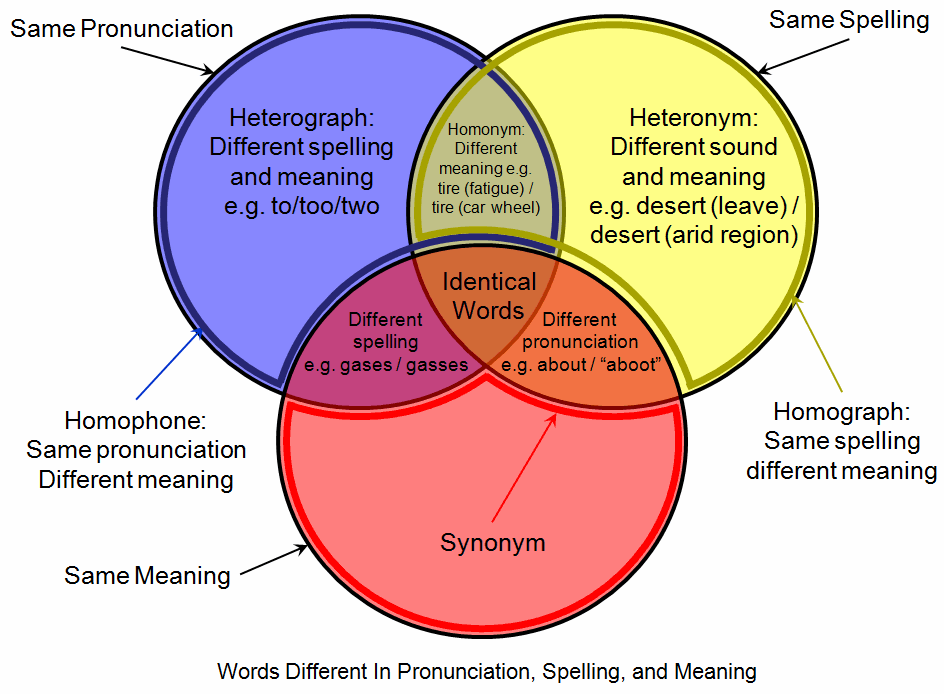
To be precise, words like ברברי/ברברי with different pronunciations and meanings are called heteronyms. Here is a nice Venn diagram illustrating the differences between synonyms, homonyms, homographs, homophones, heteronyms, and heterographs.
I say 'semi-coincidence' because in fact the words are likely etymologically related. Many Berbers prefer to use the native term Amazigh (pl Imazighen) for the people and Tamazight for the language, to avoid any pejorative connotation. However this has its own problems, as there is also a dialect of the Berber language which itself is called Tamazight and whose speakers are Imazighen, to the exclusion of other Berber dialects.
To be precise, words like ברברי/ברברי with different pronunciations and meanings are called heteronyms. Here is a nice Venn diagram illustrating the differences between synonyms, homonyms, homographs, homophones, heteronyms, and heterographs.
Monday, December 13, 2010
Tzofen-Switching
Recently I was reminded of a case study I saw in the book Language Contact, by Yaron Matras. The first chapter describes the language acquisition of a child growing up trilingual in Hebrew, German, and English. There's a lot of interesting analysis of how he juggles the languages at different points of development and in different settings.
On page 18 Matras brings a particularly interesting example. The child, two years old at this point, is playing in the back garden with his father, to whom he normally speaks in Hebrew. The boy remarks:
Although superficially one might try to compare this case to the development of Yiddish, really the situation is in many ways the opposite. With Yiddish a widely-used language (a German variety) was influenced by a prestige language (Hebrew) which the average person did not command as well. In this case the native language is being influenced by another language precisely because it is spoken better. It's telling that in this case the inserted words were function words (e.g. ob 'whether') while Yiddish loanwords tend to be content words (e.g. חתונה 'wedding').
In any case, I'm curious about how bilingual native English/Hebrew speakers code-switch when speaking in Hebrew. In general it seems that Modern Hebrew is more amenable to accepting foreign nouns than verbs. Looking at loan words, which I presume develop from code-switching, Hebrew has got plenty of English nouns (do I really need to give you an example?) but few verbs (cf. the clumsy examples לטלפן, לטרפד). Open question: What does one do to insert an English verb into Hebrew conversation? Is it possible?
On that note, I recommend reading the short article Creative Uses of English Words in Hebrew, by Liora Machauf, available here.
On page 18 Matras brings a particularly interesting example. The child, two years old at this point, is playing in the back garden with his father, to whom he normally speaks in Hebrew. The boy remarks:
- mistakel ob xilazon da ist
- look.SG.M whether snail there is
- 'I am looking to see whether [a] snail is there'
Although superficially one might try to compare this case to the development of Yiddish, really the situation is in many ways the opposite. With Yiddish a widely-used language (a German variety) was influenced by a prestige language (Hebrew) which the average person did not command as well. In this case the native language is being influenced by another language precisely because it is spoken better. It's telling that in this case the inserted words were function words (e.g. ob 'whether') while Yiddish loanwords tend to be content words (e.g. חתונה 'wedding').
In any case, I'm curious about how bilingual native English/Hebrew speakers code-switch when speaking in Hebrew. In general it seems that Modern Hebrew is more amenable to accepting foreign nouns than verbs. Looking at loan words, which I presume develop from code-switching, Hebrew has got plenty of English nouns (do I really need to give you an example?) but few verbs (cf. the clumsy examples לטלפן, לטרפד). Open question: What does one do to insert an English verb into Hebrew conversation? Is it possible?
On that note, I recommend reading the short article Creative Uses of English Words in Hebrew, by Liora Machauf, available here.
Subscribe to:
Posts (Atom)